
Purpose
Reflective writing helps people learn, and it helps them transfer their learning to new contexts. Those may seem like bold claims, but there is ample research to support them. In fact, it would be difficult to overstate the value of reflective practice for students. And it turns out that when teachers assign reflective writing, they benefit too!


Benefits
- Research shows that students who practice reflection:
- develop the ability to plan and problem solve (Reid)
- build conceptual understanding (Doe, Pilgrim, and Gehrtz)
- understand their learning process and appreciate their learning development (Gorlewski and Greene)
- improve their overall learning performance (Bransford, Brown, and Cocking)
- construct a learning identity (Whitney, McCracken, and Washell)
- develop self-regulation (Chaterdon), self-assessment (Yancey), and other dispositions of lifelong learners (Ryan)
- transfer their skills and knowledge to new contexts (Taczak and Robertson) including the workplace (Simper, Gauthier, and Scott)
- For teachers, research shows that reflective activities and assignments can:
- improve student reading and supports classroom discussions (Sage and Sele)
- reveal how students understand and apply conceptual knowledge (Reed and Williams)
- provide evidence of students’ nonlinear developmental trajectory (Sims et al.)
- supply information other assessment tools can’t: what, how and why students learned (Yancey)
TESTIMONIALS
What do professors and students say?

“Process Experience”
Reflective writing is the best way to measure learning from experience. There are other ways to demonstrate learning, but to do it in a way that is measurable, and that speaks to [the student’s] capacity to process experience, writing is the key.

“Transformative”
Incorporating reflective writing into my course has transformed the way students engage with the material—rather than just memorizing concepts, they critically analyze their learning, connect it to real-world applications, and develop a deeper sense of personal and professional growth.

“Understand Concepts”
Before using reflective writing, I mostly just memorized facts for tests. But once I started reflecting, I began to understand how the concepts applied to my life and goals. It changed the way I learn.
Research on Reflective Writing
Here are some fascinating results from studies done on reflective writing. Cited below are the published articles. Find more research on the Scholarship page.
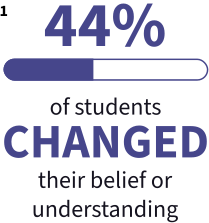


1 Reflective writing for enhancing knowledge integration in modularised study programmes
Liudmila Mikalayeva, Stoyan Panov and Elina Schleutker
To prevent the fragmentation and encapsulation of knowledge, the authors created a reflective writing exercise, “Building Bridges,” that requires students to find connections between courses.
2 Developing college students’ critical thinking through reflective writing
Hui-Chin Yeh, Shih-hsien Yang, Jo Shan Fu and Yen-Chen Shih
This mixed methods study found that through reflective writing, students improved in critical thinking, self-worth, volunteerism, patience, and gratefulness.
3 A Method for Assessing Reflective Journal Writing
Margaret M. Plack, Maryanne Driscoll, Sylvene Blissett, Raymond McKenna and Thomas P. Plack
The coding schema developed [from this study] provides a mechanism to assess evidence of reflection in written journals, which enables instructors to evaluate student competency, obtain a baseline for facilitating reflective practice, and assess their own efficacy.